
Team Balata Makes 7 Predictions About the Future of the IT Industry
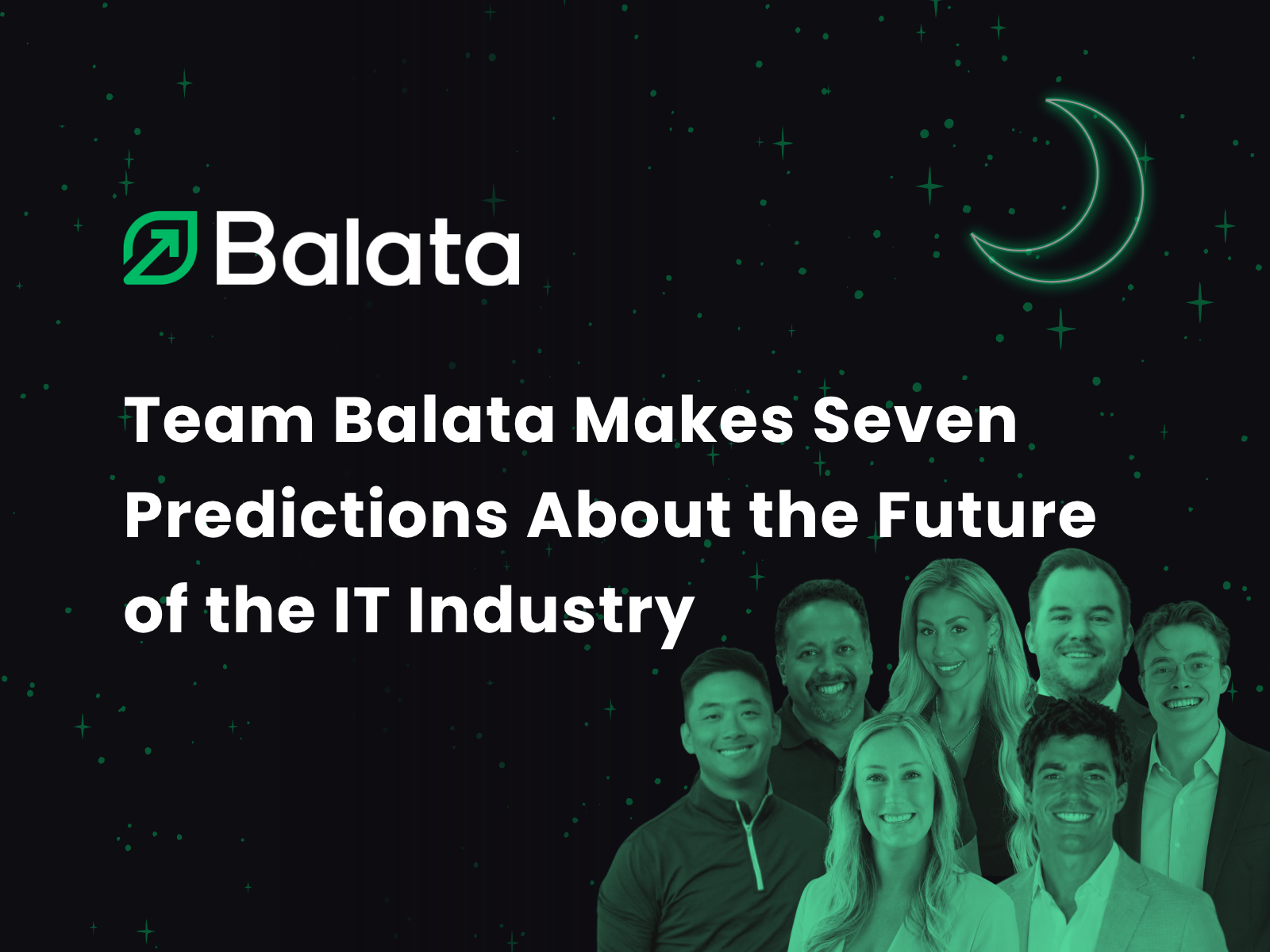
At Balata Data, we spend a lot of time analyzing the horizon to anticipate what's next for the IT and data landscape. Today, seven of our forward-thinking team members have predicted what is next for the IT industry over the next year.
Prediction One, Kartik Krishnan
The future of the IT industry is in orbit.
If you ask me for my biggest prediction for the next 12 months, it isn't about a new software framework or building another massive terrestrial server farm. My prediction? The groundwork for the orbital data center revolution is happening right now, and it will fundamentally change how we power our digital future. As AI workloads scale exponentially, our reliance on conventional, gigawatt-thirsty terrestrial data centers is hitting a physical and environmental wall. Power grids are strained, and the land and water required for cooling are becoming scarce. The solution to our terrestrial constraints is literally above us.
Here is why space-based infrastructure, spearheaded by companies like SpaceX, is the biggest trend to watch over the coming year:
1. Harnessing Perpetual Solar Energy
By placing computing clusters in high-altitude, sun-synchronous orbits, these floating data centers can bypass the day/night cycle and weather constraints of Earth. They will harness constant, perpetual energy directly from the sun. SpaceX’s new “AI1” platform and their proposed "Star-mind" AI constellation are explicitly designed with massive deployable solar arrays to capture this uninterrupted power, turning space into the ultimate renewable grid.
2. Bypassing Terrestrial Bottlenecks
Building a gigawatt data center on Earth requires years of grid approvals, environmental impact studies, and massive water resources for cooling. Orbital facilities shift that energy burden entirely off world. Over the next 12 months, expect to see a massive shift in capital, fueled by events like SpaceX's recent historic IPO, funneled directly into infrastructure. We are going to see the rapid scaling of facilities like the "Gigasat" factory in Texas, designed specifically to mass-produce these AI-compute satellites.
3. The Vacuum as a Heat Sink
Cooling in space presents its own unique physics challenges; without air or water, systems must shed heat by slowly radiating it away into the vacuum of space. The design of these next-gen orbital nodes features specialized thermal radiators to manage the intense heat of sustained AI computing. It is a massive engineering hurdle but one that the brightest minds in aerospace are actively solving today.
The Reality Check
It is not all doom and gloom; human power (now termed as the meat stack) will still have jobs to do, especially when AI agents will hire them for work that they cannot possibly do. Being candid, we won't have the entirety of the internet running in space by mid-2027. The next 12 months will not be about total deployment, but rather proof-of-concept launches, massive manufacturing build-outs, and intense regulatory debates. There are very real hurdles regarding launch costs, space debris, and the international governance of monopolized off-world infrastructure. However, the pivot has undeniably started. The conversation in IT boardrooms is beginning to shift from "Where can we find land and power?" to "How quickly can we launch?" At Balata Data, we are keeping a close eye on this orbital shift because it has the potential to redefine the limits of data processing, AI scalability, and global sustainability and our job of keeping the lights on never ceases as we continue to monitor and assure you of a minimal or zero down time.
Prediction Two, Ethan Wynn
IT asset disposition, especially data center ITAD, will become one of the fastest growing and most strategically important areas of the IT industry over the next 12 months.
AI has kicked off a massive wave of data center investment, but not every project will make it clean from announcement to operation. Power availability, water usage, zoning fights, noise concerns, sustainability pressure, and public opposition are already slowing or stopping projects in some markets. At the same time, the data centers that do move forward will face faster hardware refresh cycles as companies race to keep up with AI infrastructure demands. That combination creates a huge need for secure, compliant, and environmentally responsible asset recovery. Organizations will need partners who can manage decommissioning, data destruction, resale, recycling, logistics, and reporting at scale. I think ITAD will shift from being viewed as a back-end disposal function to a core part of IT, sustainability, and risk strategy.
Prediction Three, Jordan Peterson
We're going to see IT budgets and resources shift as organizations start to prepare for larger AI investments over the next few years.
The cost of running IT continues to increase. Hardware isn't getting cheaper, SaaS costs keep climbing, and power and data center space are becoming more expensive. At the same time, every executive team is being told they need an AI strategy. Something has to give. To free up capital, I expect many organizations to reduce spending in some areas, delay refresh cycles, consolidate tools, and look harder at operational efficiency. This is not because IT is becoming less important but because companies want to be ready to move quickly when the right AI infrastructure, platforms, and services become available. The organizations that have budget available will have options. The ones that don't, may find themselves waiting on procurement cycles, OEM timelines, or funding approvals while competitors move ahead.
The next 12 months won't just be about adopting AI. They'll be about making room for it.
Prediction Four, Stephen Conrad
The TPM industry is positioned for steady growth over the next 12 months.
This appears to be the case, as more organizations look for flexible ways to manage aging infrastructure, rising OEM costs, and tighter IT budgets (both CapEx & OpEx). For clients already using TPM, the model has proven to be reliable, cost-effective, and strategic. For those who have not fully adopted it yet, market pressures will likely force a closer look, especially as refresh cycles get delayed, and assets need to stay in production longer than originally planned. Many companies will lean on trusted partners to introduce vetted TPM providers for specific needs.
Once they see that a quality TPM provider can exceed expectations, the hybrid OEM/TPM model becomes easier to expand. With many common asset models offering open access to software and firmware, the case for broader TPM adoption becomes even stronger.
Prediction Five, Caroline Ellis
AI adoption will place new demands on existing data center infrastructure, making lifecycle management more important than ever.
Over the next 12 months, AI initiatives will continue moving from experimentation to production, creating new demands on enterprise data centers. While some organizations will invest in new GPU clusters and AI-optimized infrastructure, many will be challenged to support these workloads without completely replacing their existing environments. As budgets remain tight, IT leaders will focus on balancing investment in next-generation technology with maximizing the value of their current infrastructure. Existing servers, storage, and networking equipment will continue to play a critical role in supporting traditional business applications, allowing organizations to dedicate capital toward AI where it delivers the greatest impact. This shift will make strategic infrastructure lifecycle management increasingly important. Companies that effectively extend the life of reliable hardware through third-party maintenance can reduce operating costs and free up budget for AI innovation without compromising the stability of their core IT environment. Success won't come from replacing everything at once; it will come from making smarter decisions about where to invest and where to optimize.
Prediction Six, John Hunt
Hardware shortages will continue to be an issue into 2028 with DDR5, CPU, and high-capacity drive prices skyrocketing.
The refurbished market will continue to be a factor in IT spending decision making, and AI testing and investments will be more accessible to the mid-market and commercial space as GPU models hit the secondary market.
Prediction Seven, Shana DeWent
Power availability will become the #1 factor in data center expansion.
Historically, organizations have selected data center locations based on connectivity, real estate costs, tax incentives, and geographic redundancy. Those considerations remain important, but AI has introduced a new limiting factor: power. Modern AI workloads consume dramatically more electricity than traditional enterprise applications. As organizations deploy dense GPU clusters, many utilities are struggling to provide the electrical capacity needed to support new facilities. In many regions, available power-not available land- is becoming the primary constraint on growth.
As a result, organizations will increasingly, evaluate locations based on:
- Grid capacity
- Utility partnerships
- Renewable energy availability
- Long-term power scalability
- Energy resilience
The question is no longer "Where can we build?" It's becoming, "Where can we power it?"
.png)

.png)
Streamline, Sustain, & Scale with Balata
Discover cost-effective support solutions tailored for your enterprise data center needs today.